AB
Just someone who loves to build things... and talk about them... or anything I find fascinating š¤Ŗ
Latest posts from Diary of a silli-mazing human
-
Spain Made Me a Spoiled Kid
Jan 23 ⯠Yesterday, I had just finished grocery shopping and was walking home briskly when I noticed a young lady standing by the road, moving her arm up and down. Thatās odd, I thought. A few seconds later though, a bus pulled up in front of her. Ah! She was hailing the bus. I chuckled, because that tiny moment dragged me straight back to one of my earliest culture shocks in the UK. When I first moved here, I took my daughter to her music class one Saturday morning. I had a neat little plan mapped out in my head. Drop her off. Take the bus home ā 20 minutes. Code for 90 minutes. Head back to pick her up. It was a perfect plan⦠except the bus driver had other ideas. After dropping her off, I got to the bus stop and waited. Google Maps had said the bus would arrive in three minutes. Great. All that brisk walking was not in vain. Then I saw the bus approaching. I stood up, ready. And⦠it didnāt stop. The bus drove right past me. To say I was infuriated would be an understatement. I was livid, freezing, frustrated, confused, and offended. The next bus was in 20 minutes, which meant I had rushed, stood in the cold, and suffered... for nothing. āThis driver is wicked,ā I muttered to myself, āand either blind or just bad at his job.ā Why else would he do this to me? I frantically checked Google Maps again. Wrong stop? No. Wrong route? No. Wrong time? Also no. So I resorted to waiting another twenty long, cold minutes. About eighteen minutes in, a few other people joined me at the bus stop. I felt oddly relieved. At least if the next driver was also mad, I wouldnāt suffer alone. āWelcome my maybe future companions in sufferingā should have been how I greeted them, but I stayed quiet, because Iām not a mad person. Then we saw the bus approaching. My heart started racing. And suddenly, everyone stood up, stepped forward, and began moving their arms up and down. The bus stopped. Wait. Wait. What???? Youāre telling me the reason Iād been stranded in the cold for twenty extra minutes was because I didnāt do the arm ritual? The ritual no one told me about? No memo, no onboarding, nothing. Anyways, we got on the bus, and I was saved from the cold briefly, until I had to walk home after alighting. The Real Culprit I grew up in Nigeria. Over there, we had to actually do the arm ritual if we wanted to signal a bus or taxi to stop. The buses didnāt have schedules, so it felt normal to have to wave them down. Youād naturally find buses at a stop or just wait for one to show up. So why was this such a shock to me? Because before moving to the UK, I lived in Spain. In Spain, buses stop because theyāre meant to stop. Schedule says 10:30? The bus shows up, and stops even if no oneās there. Thatās it. That makes sense, no? If the bus is scheduled to be there, it should be there. If itās to wait for 30 seconds, it should. Someone might still be running to catch it. Spain had spoiled me. I had become a spoiled child used to having everything on a platter and living the soft life. That was the real culprit. The UK slapped me back to reality. āGirl,ā it said, āif you donāt hustle, you go nowhere. I donāt care if youāve been waiting for an hour. No arm ritual, no bus.ā So when I saw that lady confidently waving her arm yesterday, I smiled. She obviously wasnāt a JJC. She knew the rules. Or maybe like me, she once learned the hard way. Who knows? Iām not going to say I miss Spain, else my friends over there will laugh at me. They already mock me enough about the UK weather. No need to give them extra ammunition. I have many fun stories from my time moving countries and maybe Iāll write about them more often. āTil next time amigo. Have a great weekend! Hasta luego šš¾
-
Waiting is not Weakness
Jan 17 ⯠Some problems are genuinely hard, and no amount of thinking alone will magically produce the solution. That said, many problems are not new. Chances are, someone else has encountered them before, and solved them in one way or another. At Metrifox, my co-founder and I have been working on enabling clients to customize their Product Journey lifecycle, and it has not been an easy problem to crack. The idea sounds simple on the surface: let clients define what happens when a customer signs up. Should they be assigned a default plan? What happens when they upgrade or downgrade? What strategies should apply? Do they get unused credits back? What happens to unconsumed entitlements? Every time we took a stab at it, weād hit a roadblock. We would realize that a certain path, while workable today, would come back to bite us later. So weād pause, step back, and return to the drawing board. This is a real and pressing need for our clients. We could have rushed something out just to provide temporary comfort. But we knew this piece was foundational and getting it wrong would create more problems than it solved. So we waited. Nothing is new under the sun This is a proverb I heard often growing up, and it felt especially relevant this week. What are the odds that we're the first people to ever wrestle with this kind of problem? Slim to none. Somewhere, someone has faced something similar, and found a way through it. This meant that we didnāt have to invent everything from scratch. We could learn from existing patterns, prior art, and the collective experience of those who came before us. So, instead of doubling down on what the architecture should be based on how our system worked, we doubled down on more research on how different scenarios had been tackled by other companies. You might be wondering whether we did any research at the start. Of course we did. But in hindsight, it wasnāt enough. We hadnāt found the missing piece yet, and the breakthrough only came after reading more, asking better questions, and widening the lens. Waiting is not Weakness We finally had a breakthrough yesterday, and one thing my co-founder said with so much joy on his face was: āIām so glad we waited.ā Sometimes, you know something isnāt right, but because youāre under pressure to stay in motion or to show āprogressā, you go ahead and act anyway, even when youāre not fully convinced. Sometimes, what you actually need is more data, and thatās okay. If youāre sure a path isnāt the right one, wait until you find the right path. You will find it, Iām confident of that. Just donāt do the wrong thing simply because you feel the need to do something. Sometimes, doing nothing is the better decision. Ah, that sounded like a quote. Donāt do the wrong thing simply because you feel the need to do something. Sometimes, doing nothing is the better decision. Abiodun Olowode, Jan 2025 Iām learning that restraint is a skill. Speed without clarity serves no one. The world may reward speed in the short term, but building something long-lasting rewards honesty, patience, and the courage to wait. Not everything needs an immediate answer. Itās okay to pause and think again. āTil next time amigo, have a great weekend šš¾
-
Vibe-Suffering, Vibe-Hiring, Vibe-Parenting or nah?
Jan 09 ⯠Itās another Friday. I was so occupied through the week that I didnāt have time to think about what I was going to write about today. Nevertheless, as usual, I picked up my laptop this morning with one clear rule: I have to write something. So I guess Iāll just go with the flow. Itās going to be a day of⦠vibe-writing š Speaking of vibing; Itās very common to hear people say, āGo with the vibe.ā What they usually mean is: go with the flow and assume everything will work itself out. From my experience, thatās not always the case. In fact, it can be dangerous sometimes to just āgo with the vibeā and expect things to magically fall into place. At some point in life, you have to be intentional. Intentional about your life, your health, your business, your goals. Going with the vibe isnāt bad in itself, but you need to know when itās appropriate. Iām vibe-writing now, but this piece is low-stakes. Worst case, you suffer through a slightly unstructured post. Best case, the vibe is the sauce that gives it life. Either way, the consequences are minimal. If it doesnāt work, Iāll be more intentional next time. Maybe I lose a few subscribers, maybe it serves as a useful experiment; Iām fine either way. You canāt afford to do this in every area of your life, though. Trust me. Unless, of course, vibe-suffering is your thing š« Vibe-Suffering is not my thing This week, I had a DEXA scan. I didnāt want to vibe through life, assuming I was strong and healthy when, in reality, I might not be. In my last post, I talked about how, as we grow older, muscle becomes a strong marker for longevity. I also talked about birthday gifts. Turns out, both conversations collided. Someone asked me what I wanted for my birthday and, after thinking about it for a while, my answer surprised even me: a DEXA scan. I wanted to know where I actually stood; my body composition, what was working, and what needed to change; so I could start working on it now, not later. My thought process was simple: would I rather optimise my health based on vibes, or based on real, actionable data? I chose the latter, because vibe-suffering is not my thing. Iād rather not reap the consequences of not knowing. Vibe-Hiring is also not my thing Let me tell you a funny story. Iāve vibe-hired once, and it backfired spectacularly. Another bad hire wasnāt technically vibe-hiring, but it was based solely on a referral. Honestly, Iād classify both as the same thing: vibe-hiring. I donāt do either anymore. If I were to define vibe-hiring, I would say itās not putting the right amount of work or following due process when hiring, and assuming everything will work out based on vague signals. Those signals could be what youāve heard about the person, how you felt talking to them, how well they speak, or some other intangible āvibe.ā In reality, when you hire someone, you want them to do a job. They need to prove that they can do that job, not talk to you about when they did such a job, but actually do the job. Sometime last year, I really needed a frontend engineer, so I asked for some resumes. I spoke with one candidate whose resume caught my eye. He walked me through a business he had started, a software platform for event booking, and the users he already had. He explained how it ran mostly on its own and how he occasionally made improvements. He talked about his approach to documentation and processes. I was blown away. In my head, this guy was going to bring huge experience to the team and help us smash our goals. Alas, I was vibe-hoping. No wonder those hopes were vibe-smashed. We hired him. And then the pain began. He wouldnāt show up for meetings. When he submitted work for review, there were no descriptions. You could point out the same issues on one pull request and find them repeated on the next three. It was utter chaos. He didnāt last two weeks; but I learned my lesson. Now, before hiring, every candidate does a paid, one-week embedding with us. We give them tasks, see how they show up, how they collaborate with the team, and gauge the quality of their work. It also helps us understand what level they fit into. I wonāt claim this is 100% failure-proof, but itās a solid start to prevent premium tears. Vibe-Parenting Last week, my 7-year-old decided to start his own blog. Itās been some good comic relief for me, and for some of his subscribers. Heās been committed to writing every day since he started. I donāt know how long heāll keep it up, but the funny thing is: he only started because he saw me consistently write on Fridays. Heād come into my room in the morning and ask what I was doing. Iād say, āItās Friday, Iām writing,ā like it was a no-brainer. Last week, when I gave that same answer, he and his sister decided I couldnāt be the only ācool kid on the blockā. And so, they started their own blogs. Iāve never thought of myself as a āgoodā parent. Iām just⦠a parent. Thereās honestly no manual for this. If you ask me, many parents are just vibe-parenting, going with the flow, doing their best, and hoping itās good enough. And when youāre dealing with a full human being, many times, thatās really all you can do. Children will test your patience. Youāll cry. Youāll be mad. And then theyāll make you laugh by saying the darnedest things, leaving you wondering how their tiny brains even work. Being a parent is an important job; maybe the most important in the world, and itās one place we need to try to avoid āgoing with the vibeā. We need to be intentional. This past week taught me one simple way to be an intentional parent ā by being intentional about myself. Kids notice these things, and they pick it up. So, there we go. Looks like vibe-writing wasnāt so bad after all. Like my son would say at the end of his blog posts: āThanks for reading, and come back next time!ā š
-
Dancing, Dumbbells, and Decisions: My 2025
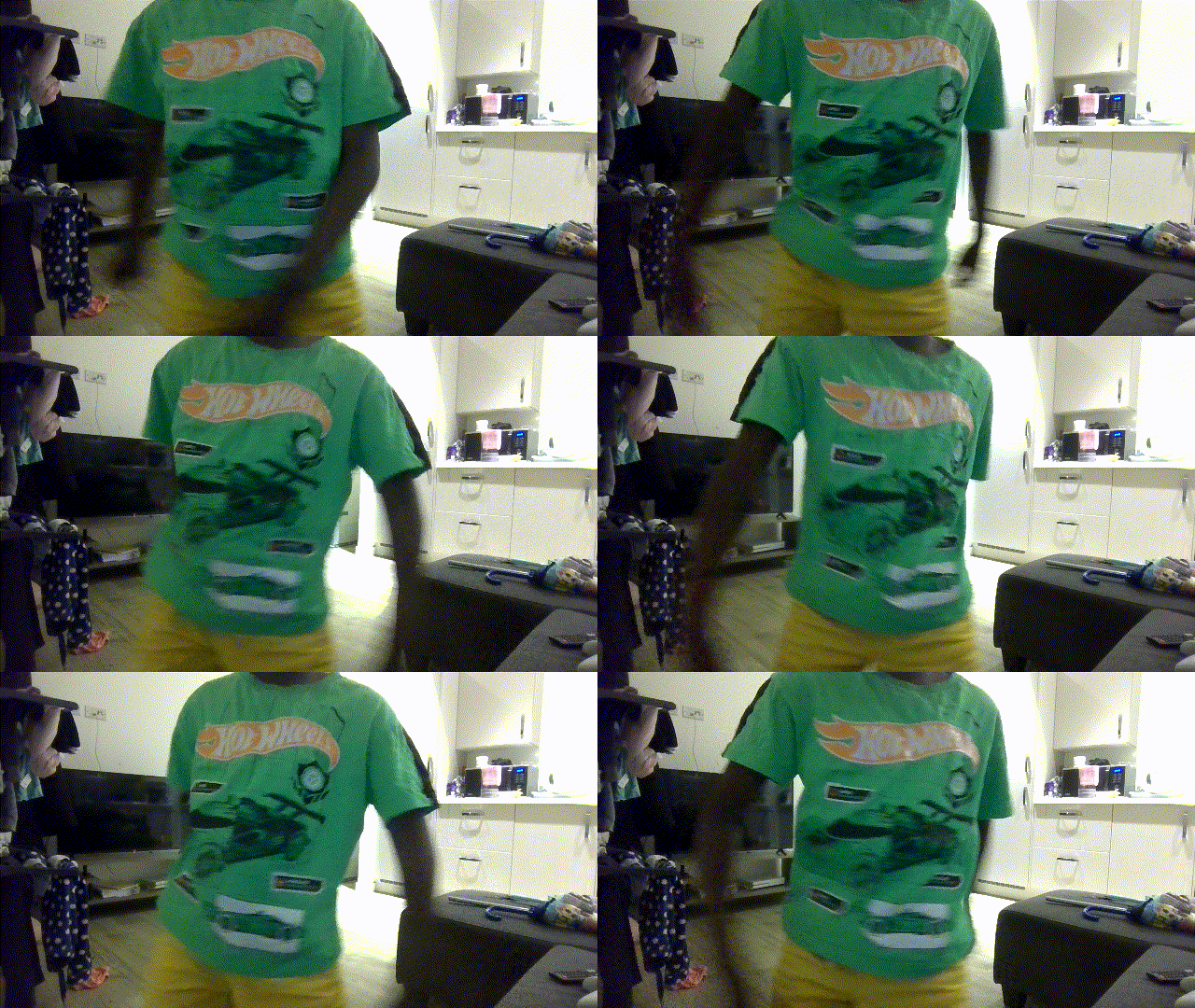
Jan 02 ⯠The New Yearās Day has a funny way of losing its magic as you get older. At some point, it stops feeling like a reset or a day for ānew year resolutionsā and starts to feel like... just another day. Yesterday was my birthday. Yes, I was born on New Year's Day. My birthday wishes usually sound something like, āHappy New Year⦠and happy birthday too.ā And honestly, Iāve made my peace with it. My birthday canāt hustle for fame with New Yearās Day; it will always win and take preeminence. The wishes sometimes sound like an afterthought, and to be honest, thatās fine. Like many things in life, itās all about perspective. The way I see it, no one can claim my birthday fell on an insignificant day, and thatās why they forgot. This translates into less excuses, more gifts⦠hehe. The writer doing a celebration danceFor me, 2025 was a year of many moves. Not dancing moves; please don't get carried away by my legit stepper skills above. Focus. What I mean is that I made changes. Some small, some massive. Some scary, some surprisingly easy. Looking back now, I don't think at the start of the year, I could have predicted most of them. And since we're on the topic of moves, let's talk about movement. My Standing Desk and Walking Pad "There's no such thing as a healthy sedentary person." I heard this on a podcast, and I froze. I paused it, took a breath, then rewound to hear it again. As a programmer, most of my work happens at a desk: sitting, keyboard clanking, brain fully locked in on building the next thing. Itās easy to measure success by shipped features and fixed bugs. The question I had to ask myself was: Is my health winning too? So I made a change. My desk now lives in standing mode. Permanently. And I added a walking pad underneath it. Yesterday wasnāt even a workday, yet I still racked up minutes just by being at my desk, doing a few things here and there. I no longer need to āgo outā to walk. I walk indoors too. And since weāre on the topic of exercise, letās talk about weights. My Weights Let me tell you a secret. I own 4 kg dumbbells. I bought them around August 2024 to start lifting weights. I had never lifted weights in my life, so 4kg felt like a sensible place to begin. Then they arrived. My six-year-old picked them up. Not only did he lift them; he started flexing his arms up and down with them. I panicked for a second, then paused. He looked fine. Then my older child picked them up too. No struggle. No complaints. I just shook my head and walked away. What was I thinking? Funny enough, I never really committed to lifting after that. Iād occasionally pick them up after my walks and convince myself I was doing something. Then I read a post on LinkedIn about how, as you get older, muscle becomes one of the strongest markers for longevity. That hit. If the universe couldnāt reach me through my kids, maybe a total stranger was the key. So I doubled the weights. I got 8kg dumbbells and a pull-up bar. A picture of 4kga nd 8kg dummbells As you can imagine, these dumbbells are not as friendly as the 4kg ones. My kids canāt lift them up and down anymore. I finally feel like an adult⦠at least until they humble me again. The point is this: Iām intentionally pushing myself to be stronger. Being lean is good. Being lean and strong is better. And since weāre on the topic of strength, letās talk about the strength to make hard decisions. Quitting My Job In August 2024, I moved to the UK to take up a role managing engineering teams at a FinTech company approaching unicorn status. It came with a solid six-figure salary, and in my mind, I was in it for the long haul. Late in 2024, my now co-founder reached out to me with a billing idea. Nothing had been built yet. It was just a problem he wanted to solve and a belief that I could help make it real. My answer was an immediate no. I had just moved countries. I had a new job. There was no universe in which I was quitting stability to build an idea that didnāt even exist yet. I wished him well and even connected him with people who might be interested. He didn't stop. Every now and then, heād message me about usage-based billing and complex computations. Heād ask how Iād approach certain things, and Iād reply casually. At some point, it felt like I should start invoicing him for consulting. Still, I wasnāt interested... or so I thought. Eventually, I agreed to explore it on the side. Emphasis on āon the side.ā Iād keep my job, keep doing well, and poke at this idea in the evenings. No harm done. Except the more I explored it, designed systems, thought through edge cases, spoke to potential users, the more excited I became. There was something here. What started as an internal billing idea for one of his companies quickly revealed itself as its own product; its own company. I convinced him it needed to stand alone, and thatās how Metrifox was born. I was now a co-founder, but still, quitting my job wasn't an option. However, reality caught up. If this was going to move fast and be done well, nights and weekends wouldnāt cut it. So, in July, I made the decision to go full-time, even though Metrifox had no money, and we were still building. I no longer earn a six-figure salary. But I wake up excited. I talk to customers, build features, design systems, and solve problems that are mine. I couldnāt say the same about my old job. What I learned is this: I may be good at managing engineering teams, but my sweet spot is building while managing. Iām an engineer at my core, and thatās something Iāll never give up. Find your sweet spot. And when you do, have the courage to choose it. Since weāre on the topic of courage, letās talk about the courage to let go. Letting Go of My Idea of āSecurityā At the start of 2025, I set a financial goal. I had a well-paying job, and it felt attainable. By the end of the year, I was close. My plan was simple: hit the target, leave the money alone, dip into the interest when necessary, and maintain a baseline that made me feel secure. Then an unexpected family project kicked off. On paper, it was a good move; but it meant dipping into my savings. Without a steady salary anymore, rebuilding that number would take time. I wrestled with it. I had dreamed of that number throughout the year. Could I just let it disappear? The thought alone gave me chest pain š So I called a dear friend, my finance guru, the one who had first convinced me to set this number in the first place. I relayed my dilemma. He laughed and reframed it: "Youāve built a bank. Letās call it Biodun Bank. Now go there, take a loan, and fund this project. This isnāt about the number. Youāve already proved you could build it. The point is, you can access it when you need to." And he was right. I had to let go of my old idea of āsecurity.ā It had served me during the building phase, but now I was in the borrowing phase. Clinging to it would have held me back. The lesson: life moves in phases. The mindset that worked in one phase may no longer serve you in the next. Have the courage to let go, pivot, and use what youāve built to take the next step. Phew! This one has felt like a long write. I could go on, but letās save the rest of my 2025 stories for another time. Wishing you a happy and fulfilling 2026, amigos. 'Til next time, keep winning ā¤ļø
-
Problem No Dey Finish
Dec 19 ⯠āThatās not a place you cry when you donāt understand something.ā My brother said that to me twenty years ago when I was getting into university. Jeeeezzzzz! Has it really been that long? š± Looks like someoneās getting old. I digress. Excellence has always been a value of mine. I grew up hearing the phrase, "Anything worth doing is worth doing well." It's one of the ones you can say really sunk in. Early on, I hacked the process. I realized that if I truly understood the how, I could solve almost anything. As a result, I wasnāt intimidated by complex questions. In fact, I craved them. Math, Physics; the harder, the more exciting. Solving them was proof that I understood the concept, not that Iād memorized it. And when I couldnāt solve them? Well⦠I cried. Sometimes, I wailed. Loudly. My dad would often ask my brothers to help me out. So, by the time I was getting into the university, they felt justified in drilling it into me: Madam, that is not the place for crying. If you donāt understand something there, youād better find another way to deal with it. And honestly? They were right. Crying as a founder? Fast-forward two decades. Iām a founder now. And Iām⦠not crying anymore. Excellence is still a value of mine. I still want everything worth doing to be done well. I want things to work. I want every bug a user encounters to be a rare anomaly. I want happy usersāalways. But as you probably already know, everything will not always work. There will always be an edge case you didnāt think about during implementation. Something that makes a user pause and say, āUhmm⦠what just happened?ā (You can ask Probound; they started integrating with Metrifox this week š ) But what does that mean? That our work isnāt excellent? That we should throw in the towel and start another venture? Hell to the no! On the contrary, it signals that there is something equally important we should pay attention to: How fast we respond when something goes wrong. How quickly do we move from: āThereās a problemā to āWe understand the problemā to āThe problem is fixedā; or at least, āItās no longer a problem⦠for now.ā In incident management, this is called MTTR ā Mean Time To Recovery (or repair, response, resolve). Itās simply a measure of how fast you go from incident to all-clear. And honestly? This concept applies far beyond engineering. MTTR For You In life, I think of MTTR as a measure of resilience. When something goes wrong, how long does it take you to move from wailing about the problem to acknowledging it and forging ahead? And let me be clear: You are allowed to wail. The question is: does it take three minutes or three days? The same applies to business. No matter what kind you run. How quickly do you respond to customer issues? How fast do you move from "this is unexpected" to "okay, we're here now, what's the way forward?" You canāt prevent every problem. Thatās unrealistic. And every time something breaks, you canāt cry like a certain younger version of someone we know. So what can you do? Acknowledge. Feel. Strategise. Implement. And when that solution uncovers another problem? You rinse. And repeat. Sometimes, you donāt even need the feel step; you move straight to strategy and execution. Other times, you do need to sit with it for a bit. Just⦠donāt spend one year feeling. Get up. Dust yourself off. And move. Problem no dey finish There is a Nigerian saying: "Problem no dey finish." It simply means problems donāt end. The earlier you accept that challenges are part of lifeās journey, not interruptions to it, the easier it becomes to breathe, recalibrate, and ask, āOkay... how do we proceed?ā Ah! did I just smell a quote? š The earlier you accept that challenges are part of lifeās journey, not interruptions to it, the easier it becomes to breathe and recalibrate. Abiodun Olowode, Dec 2025 So, dear reader, get comfortable. Weāre here for the long haul. āTil next time, amigo. And always remember⦠problem no dey finish š
-
My Innie vs My Outie: The War
Dec 12 ⯠I watched the mind-bending Severance series a few months ago. It wasnāt bad at all. I canāt remember who recommended it; most likely my sister. Movies are one of the things my siblings and I bond over. We recommend them to each other like a relay of survival: If you suffered through it, I donāt have to. You suffer for all! The Innie & The Outie In Severance, thereās this concept of an "innie" and an "outie." Humans who agree to the procedure have their work selves separated from their non-work selves. When they step into the work elevator, something flips. Their āwork selfā (the innie) switches on. The innie knows nothing about the outside world. No idea who their family is. No context. Just fluorescent lights, cubicles, and coworkers. The outie, on the other hand, knows nothing about their work life. Once they leave the building, their work persona essentially disappears. They are back to their home selves. If they ran into a work colleague at the supermarket, they would not even recognize them. The Dialogue At some point, the main characterās outie needs to communicate with his innie. The process is exhausting. They send each other voice notes like two people in a long-distance relationship with terrible WiFi. At one point, they are basically screaming through recorded messages. Why? Because they want different things. They both think the other one is unreasonable. The outie wants to get his "dead wife" back. The innie is in love with a coworker and wants to keep living that life. And neither desire can exist without threatening the other. If the innie helps the outie get his wife back, the outie would have no reason to return to work. If the outie refuses to return to work, the innie loses his entire world. Itās a mess of incentives, trust, sacrifice, and identity. Do I Have an Innie and an Outie? š¤ Sometimes I feel like I do. A whole war happening inside my body. My innie is my internal system. The strict one. The one running the operations. My outie is the me that interfaces with the world. The vibes. The craving. The one that wants to be carefree. My outie loves ice cream; salted caramel especially. She could chug a whole bowl and still ask for more. My innie hates ice cream. She punishes the outie every chance she gets: huge breakouts, painful pimples, angry red swellings. It's chaos. So when I watched Severance, one of my first thoughts was: How can I communicate with my innie so she understands that ice cream is a guilty pleasure and she needs to stop throwing tantrums? What would that conversation look like? Outie: I love ice cream. Itās literally the best thing in the world. Innie: Itās processed sugar. That nonsense is not good for you. Outie: Must you be so strict? Please. YOLO. Innie: Iām not going to be chill with you bringing that thing near me. Outie: Youāre selfish and rigid. No empathy. š Innie: š„± Outie: What about once a week on Fridays? š«£ Innie: ā¦silence A compromise? There are things we both want. When I decide Iām going to do something great; something genuinely exciting, my innie is hyped. I can code for hours and she wonāt even whisper about food. Iāll be like, āWhy am I not hungry?ā and I can imagine her saying: āWeāre changing the world, please. Focus.ā But what about the things I want that she doesnāt want? The external conflicts where I insist on having my way, even though I know sheāll be mad? I have sticky notes on my desk with reminders about the "whys" and the "consequences." They barely help. Even when I resist a craving, I still have to deal with the craving. And where is my innie then? Nowhere! She is just relieved we did not bring the ice cream near her. My Response To my Innie Iāve noticed something interesting over the years though. When Iām aligned with my innie, we can do anything. We can change the world. When weāre misaligned, one of us suffers. And when one of us is suffering, both of us are, inadvertently. So when it comes to fulfillment, passion, and drive (the things that keep me alive), and by alive I donāt mean just existingāthe things that make life more than a loop of waking up, doing things, and going back to sleep⦠those are the areas where I make sure weāre fully aligned. But for the things my innie is unnecessarily rigid about, like salted caramel ice cream? My response is: āMaāam, youāll be all right.ā Until she decides to learn to enjoy the little things (in moderation), Iām living life with the slogan: āWhoās a couple of pimples gonna hurt?ā š¤Ŗ Have a lovely weekend, amigo, and thank you for reading ā¤ļø By the way, the double cream in my fridge is calling my name⦠and my ice cream maker is ready for duty.